Potty Training Seat: The Complete Guide to Choosing the Right One
Everything you need to know before buying a potty training seat — types, key features, safety considerations, and a step-by-step training approach that sets your toddler up for success.
Explore the Buying GuideWhy this guide matters: Choosing the right potty training seat can make the difference between a smooth transition and a frustrating experience for both you and your child. This guide walks you through every consideration so you can make a confident, informed decision.
Why the Right Potty Training Seat Matters
Potty training is a major developmental milestone, and the seat your toddler uses plays a surprisingly large role in how the process unfolds. A well-designed seat provides physical stability, comfort, and confidence — three factors that directly influence whether your child feels secure enough to relax and go.
An ill-fitting or unstable seat, on the other hand, can create anxiety, lead to accidents, and prolong the training period. Since toddlers are naturally eager to please but also easily discouraged, the physical setup needs to remove as many barriers as possible.
Beyond comfort, the right seat also supports proper posture. When a child's feet are supported and their body is stable, the pelvic floor muscles can relax — which is exactly what needs to happen for a successful bowel movement. This is why many pediatric occupational therapists recommend seats with footrests or ladders that allow the feet to rest flat.
Types of Potty Training Seats
There are three main categories of potty training seats, each suited to different stages and preferences. Understanding the differences will help you narrow down the right choice for your child's personality and your household setup.
Standalone Potty Chair
A freestanding unit that sits directly on the floor. Ideal for beginners because it is low to the ground, less intimidating than an adult toilet, and fully portable — you can move it from room to room or bring it on trips.
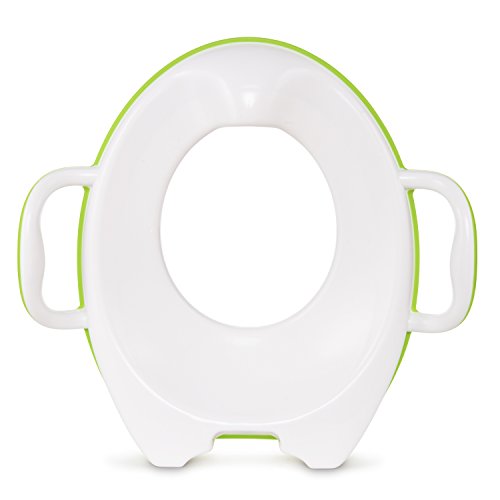
Essential tierToilet Topper Seat
A contoured seat that fits over the adult toilet bowl. Best for toddlers who are comfortable with the bathroom environment and want to use the "grown-up" toilet. Some models fold for easy storage and travel.
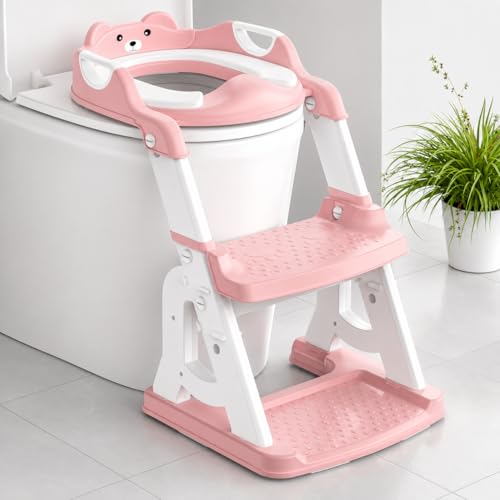
Mid-tierToilet Topper with Ladder
Combines a contoured seat with an integrated step ladder, allowing your child to climb up independently and rest their feet on a stable platform. Excellent for promoting autonomy and proper posture during training.
High-end tierIf you are leaning toward a ladder model, explore our detailed guide on potty training seats with ladders to compare stability features, step designs, and safety considerations. For a broader overview of standalone options, see our collection of potty training seats.
Key Features to Compare
Not all potty seats are created equal. The table below breaks down the most important features across the three main categories, using a consistent tier framework to help you match your needs with the right level of product.
| Feature | Standalone Potty Chair | Toilet Topper | Topper with Ladder |
|---|---|---|---|
| Stability on floor | Excellent — wide base sits flat | Good — relies on toilet rim fit | Good — ladder adds support |
| Foot support | Built-in — floor-level feet | None — feet dangle | Excellent — ladder steps act as footrest |
| Portability | High — carry anywhere | Medium — fits in bag | Low — bulky to transport |
| Ease of cleaning | Easy — removable bowl | Very easy — nothing to empty | Very easy — nothing to empty |
| Independence for child | High — child can sit alone | Medium — may need help up | High — ladder enables solo use |
| Space required | Moderate — dedicated floor spot | Minimal — stores on toilet or hook | Moderate — needs clearance in front of toilet |
| Best for | Beginners, travel, small bathrooms | Confident toddlers, quick transitions | Older toddlers ready for full independence |
When comparing within a category, pay attention to construction quality. Entry-level models often use lighter plastic and simpler splash guards, while mid-range and high-end tiers typically add non-slip rubber grips, contoured seating surfaces, and reinforced hinges on ladder models. These details matter for daily use over many months.
How to Choose: A Step-by-Step Buying Framework
Use the following framework to narrow your options systematically. It is designed to help you move from "I know I need a potty seat" to "I know exactly which one fits my child and my home."
- Assess your child's readiness and personality. Is your toddler curious about the bathroom or hesitant? A child who is nervous around the adult toilet may do better with a standalone chair first. A child who wants to imitate older siblings may prefer a topper with a ladder.
- Measure your bathroom space. Topper-with-ladder models need clear floor space in front of the toilet for the child to climb safely. Standalone chairs need a dedicated corner but can be moved as needed.
- Decide on portability needs. If you travel frequently or want a seat for grandparents' houses, a folding topper or lightweight standalone chair is the practical choice.
- Check stability and safety features. Look for non-slip bases, secure ladder locking mechanisms, and smooth edges. A splash guard is essential for boys — choose a higher front lip or a removable guard.
- Evaluate cleaning convenience. Removable bowls on standalone chairs should lift out easily. Topper seats should have smooth, crevice-free surfaces that wipe clean in seconds.
- Consider longevity and transition. Some standalone chairs convert into step stools later, extending their useful life. Topper seats naturally transition to adult toilet use, which some children find motivating.
- Match the tier to your usage intensity. If the seat will be used daily for months across multiple children, a mid-range or high-end tier with reinforced construction is a worthwhile long-term investment. For occasional travel use, a starter-tier folding topper is perfectly adequate.
For families specifically interested in the ladder style, our comparison of potty training toilet seats with ladders covers step width, locking mechanisms, and seat contour differences in detail.
Safety Considerations
Potty training is generally low-risk, but a few safety points deserve attention — especially with ladder models and elevated seats.
⚠️ Safety Checklist Before Use
- Supervise ladder use. Even the most stable ladders can tip if a child leans sideways. Stay within arm's reach until your child consistently climbs and descends safely.
- Verify the locking mechanism. Ladder legs should lock firmly into place and not wobble when weight is applied. Test this yourself before each use.
- Check non-slip surfaces. Rubber grips on the base of standalone chairs and on ladder feet prevent sliding on tile or hardwood.
- Ensure proper fit on the toilet. A topper seat should sit flush and not shift when the child sits down. Check compatibility with your toilet's shape (elongated vs. round).
- Avoid using the seat as a step stool unless the manufacturer explicitly designs it for that dual purpose. Structural integrity matters.
- Inspect regularly for cracks or loose parts. Plastic can become brittle over time, especially if dropped. Replace any component that shows wear.
A Practical Potty Training Approach
Having the right seat is only half the equation. The other half is a calm, consistent training method. The approach below is widely recommended by pediatric professionals and works well with any of the seat types discussed above.
Phase 1: Familiarization (1–2 weeks)
Place the potty seat in the bathroom and let your child explore it fully clothed. Talk about what it is for and let them sit on it during story time. The goal is zero pressure — just familiarity. If you are using a topper with a ladder, demonstrate how to climb up and down safely.
Phase 2: Scheduled Sits (2–4 weeks)
After meals and snacks, invite your child to sit on the seat for a few minutes. Keep it playful. Read a book or sing a song. Success is not the goal yet — the routine is. Praise sitting itself, not just results.
Phase 3: Underwear Transition
Once your child consistently stays dry for two-hour stretches and shows awareness of needing to go, switch to toddler underwear during the day. Expect accidents — they are part of learning. Keep the potty seat accessible and remind gently every 60–90 minutes.
Phase 4: Nighttime and Outings
Nighttime dryness often comes months after daytime success. Use training pants at night and for outings until your child is reliably dry. For overnight training strategies, see our guide on nighttime potty training.
If progress stalls for more than a few weeks, consider whether professional guidance might help. Our article on professional help with toilet training covers when and how to seek support from pediatricians or occupational therapists.
Common Mistakes to Avoid
- Starting too early. Readiness signs matter far more than a target age. Pushing before a child is developmentally ready usually backfires and extends the process.
- Switching seats mid-training. Once your child is comfortable with a particular seat, stick with it until training is well established. Novelty can disrupt the routine.
- Using punishment or shaming. Accidents are not misbehavior — they are learning moments. Stay neutral and encouraging.
- Ignoring foot support. A dangling child cannot relax their pelvic floor. If using a topper seat without a ladder, add a sturdy step stool so feet rest flat.
- Forgetting the splash guard. For boys, a seat without a front guard often means cleanup after every sit. Choose a model with a high splash guard or a removable deflector.
- Overcomplicating the setup. A simple, stable seat plus consistent routine beats a feature-heavy seat with an inconsistent approach every time.
Frequently Asked Questions
Most children are ready between 18 and 30 months, but readiness signs matter more than age. Look for staying dry for two hours, showing interest in the toilet, being able to follow simple instructions, and expressing discomfort when wet or dirty.
Standalone potty seats are ideal for beginners as they are less intimidating and fully portable. Toilet topper seats with ladders work well for older toddlers who want to use the adult toilet and can climb independently. Many families use a standalone chair first, then transition to a topper with a ladder.
It varies widely. Some children adapt within a few days, while others need several weeks or months. Consistency, patience, and positive reinforcement are the biggest factors. Nighttime dryness often takes longer than daytime training.
Prioritize a stable base, comfortable contoured seating, easy-to-clean surfaces, a splash guard for boys, and non-slip features. For toilet toppers, check that the seat fits your toilet shape securely. For ladder models, verify the locking mechanism and step width.
Most plastic seats wipe clean with mild soap and water or a disinfecting wipe. Standalone chairs with removable bowls should be emptied and rinsed after each use, then wiped down daily. Avoid harsh abrasives that can scratch the surface and harbor bacteria.
Ready to Find the Right Potty Training Seat?
Use the framework in this guide to evaluate your options with confidence. Compare seat types, check safety features, and match the tier to your family's needs.
View Recommended Seats