Infant Standing Activity Center: The Complete Buying Guide
Everything you need to know before choosing a standing activity center for your baby. Understand the developmental benefits, essential safety features, and how to pick the right model for your home and your little one's stage.
Explore Recommended ModelsWhy this guide matters: A standing activity center is more than a piece of baby gear — it is a developmental tool that supports leg strength, balance, sensory exploration, and independent play. But not every model is created equal, and using one correctly matters as much as choosing one. This guide walks you through the decision from start to finish so you can buy with confidence.
What Is an Infant Standing Activity Center?
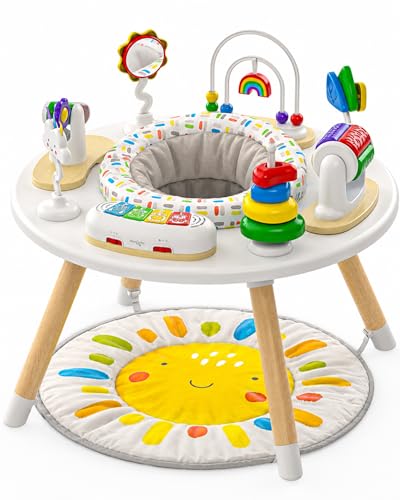
An infant standing activity center is a stationary play unit that lets a baby stand supported in a rotating seat while exploring interactive toys arranged around a circular tray. Unlike a traditional walker with wheels, a standing activity center stays in place, giving your baby a safe, contained space to bounce, swivel, reach, and play.
These units typically feature a wide base for stability, an adjustable-height seat, and a ring of sensory toys — spinners, rattles, mirrors, buttons, and textured panels — designed to engage a baby's developing senses and motor skills. Many models convert or fold for storage, and some offer growth stages that adapt as your baby becomes more mobile.
Parents often compare an activity center with a bouncer jumper or a walker with wheels. The key distinction is that a standing activity center is stationary and promotes supported standing and weight-bearing, whereas a wheeled walker allows forward movement and carries different safety considerations. For a broader look at seated and bouncing options, our guide to the infant bouncer is a useful companion read.
Developmental Benefits: What Your Baby Gains
A well-designed standing activity center supports several areas of early development at once. Here is what the research and pediatric guidance generally point to:
Leg Strength & Weight-Bearing
Supported standing encourages babies to bear weight through their legs, which builds the muscle foundation needed for cruising and walking later on.
Balance & Core Stability
Bouncing and swiveling in a supported seat helps babies practice weight shifts and trunk control in a safe environment.
Sensory Exploration
Mirrors, textures, sounds, and moving parts stimulate visual, auditory, and tactile processing during a critical developmental window.
Fine Motor Skills
Reaching, grabbing, pressing, and spinning toys strengthens hand-eye coordination and finger dexterity.
Independent Play
A contained, engaging space gives babies a sense of autonomy and gives parents a safe spot for short supervised breaks.
Visual Tracking
Colorful, moving elements around the tray encourage babies to track objects and shift focus near and far.
It is important to balance activity center time with plenty of free floor play, tummy time, and floor-based exploration. Pediatric guidance generally recommends short, supervised sessions — around 15 to 20 minutes at a time — rather than extended periods in any contained device. If your baby is not yet holding their head up steadily, they are likely not ready for a standing activity center.
Types of Standing Activity Centers and Market Tiers
Standing activity centers fall into a few broad categories, and each category spans a range of market tiers. Understanding the tiers helps you match features to your priorities without over- or under-buying for your needs.
Stationary Round Activity Centers
The classic design: a circular tray with a rotating seat and a ring of toys. These are the most common and offer a good balance of play value and stability. Entry-level models in this category typically include a basic toy ring and a simple height adjustment, while mid-range and premium versions add bouncing mechanisms, removable toys, folding frames, and multi-stage conversion.
Convertible Activity Centers
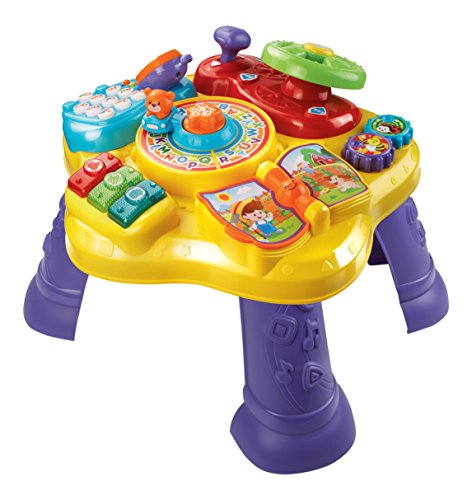
These units transform — often from a standing activity center into a play table or a toddler activity station. Convertible models sit in the mid-range to high-end tier and are a strong long-term investment if you want a piece of gear that stays useful past the standing stage. If you are planning ahead, our guide to kids activity table ideas shows how a convertible unit can bridge into toddler play.
Compact and Foldable Models
Designed for smaller homes or travel, compact models fold flat or collapse for storage. They tend to sit in the mid-tier and often trade some toy variety for portability. If space is a priority, a compact unit pairs well with other space-conscious gear like a lightweight compact stroller.
Comparison at a Glance
| Tier | Typical Features | Best For |
|---|---|---|
| Entry-level | Basic rotating seat, fixed toy ring, simple height adjustment, non-folding frame | Families who want a straightforward, dependable starter unit |
| Mid-range | Bouncing motion, removable toys, adjustable seat height, some folding capability | Most families seeking a balanced feature set and solid build |
| Premium | Multi-stage conversion, premium materials, smooth bounce mechanism, compact fold | Parents who want long-term use and refined construction |
| High-end tier | Convertible play table, extensive toy set, tool-free height changes, travel-friendly design | Families planning to use the unit across multiple stages and siblings |
Across every tier, prioritize a wide, stable base and a seat that supports a natural hip position. A well-specified mid-range model often delivers the smoothest balance of features and durability, while entry-level units can be a solid choice if you prefer a simple, single-purpose design.
Key Features to Evaluate Before You Buy
When comparing models, these are the features that matter most in daily use:
Seat Height Adjustment
Your baby's feet should rest flat on the platform with knees slightly bent. Multiple height settings let the unit grow with your baby and help maintain healthy hip and leg positioning. Tool-free adjustment is a practical bonus for busy households.
Rotation and Bounce Mechanism
A smoothly rotating seat lets your baby explore different toy stations independently. A gentle bounce adds proprioceptive feedback and engagement. Check that the rotation locks securely when needed and that the bounce mechanism feels controlled rather than loose.
Stability and Base Design
A wide base with non-slip feet is essential. Look for a low center of gravity and a frame that does not tip when a baby leans to one side. Solid build quality here is non-negotiable.
Toy Variety and Removability
Removable, interchangeable toys extend play value and make cleaning easier. A mix of visual, auditory, and tactile elements keeps babies engaged longer. Avoid designs with small parts that could detach or pose a choking hazard.
Portability and Storage
If you live in a smaller space or plan to move the unit between rooms, a foldable frame is worth prioritizing. Compact models fold flat and can tuck behind a door or into a closet.
Ease of Cleaning
Look for wipeable surfaces, a removable and machine-washable seat pad, and toy components that can be cleaned without disassembling the entire unit.
Growth and Conversion
Some models convert into a play table or toddler station, extending usable life well beyond the standing stage. If long-term investment matters to you, a convertible design is the most efficient in the long run.
Safety Checklist: Non-Negotiable Points
- Supervise at all times. Never leave your baby unattended in an activity center, even for a moment.
- Check current safety standards. Confirm the model meets applicable safety certifications and has no active recall notices.
- Use on a flat, stable surface. Place the unit on carpet or a non-slip mat, away from stairs, ledges, and heat sources.
- Respect age and development readiness. Use only when your baby can hold their head up steadily and is ready for supported standing.
- Limit session length. Keep sessions short — around 15 to 20 minutes — and balance with floor play and tummy time.
- Inspect regularly. Check for loose screws, worn seat fabric, cracked plastic, and detached toy parts before each use.
- Follow the weight and height limits. Discontinue use once your baby exceeds the manufacturer's stated limits.
For a broader context on age-appropriate gear and safety, our guide to infant chairs for sitting up covers how supported seating evolves as your baby grows, and our infant play yard guide explains how a contained play space can complement activity center time.
How to Choose: A Practical Decision Framework
Work through these questions in order to narrow your options efficiently:
- Is your baby developmentally ready? Confirm steady head control and readiness for supported standing before purchasing.
- How much space do you have? If floor space is limited, prioritize a compact or foldable model. If you have room, a full-size round unit offers more play stations.
- Do you want multi-stage use? A convertible design is the strongest long-term investment if you plan to use the unit past the standing stage or across siblings.
- How important is bounce and rotation? Bounce and smooth rotation meaningfully increase engagement; mid-range and premium models typically refine these mechanisms.
- How will you clean it? A removable, washable seat pad and wipeable toy surfaces save significant time in daily use.
- What is your tier preference? Match the tier to your priorities: entry-level for simplicity, mid-range for balance, premium and high-end for conversion and refined construction.
Once you have narrowed your shortlist, read independent reviews, verify current safety certifications, and confirm the return policy before committing.
Setup, Use, and Maintenance Tips
Getting the most out of a standing activity center comes down to correct setup and consistent habits:
- Assemble carefully. Follow the manufacturer's instructions exactly and tighten all fasteners securely. Recheck fasteners after the first few uses.
- Set the right height. Adjust the seat so your baby's feet are flat with knees slightly bent — not dangling and not fully locked straight.
- Position thoughtfully. Place the unit in a central, supervised area with a clear view, away from stairs, sharp edges, and hot surfaces.
- Introduce gradually. Start with short sessions and let your baby set the pace. Some babies take a few tries to warm up to the rotation and bounce.
- Rotate toys. If the toy ring is removable or interchangeable, rotate pieces to keep engagement fresh.
- Clean routinely. Wipe surfaces after each use, wash the seat pad according to care instructions, and inspect for wear monthly.
- Store safely. If the unit folds, store it upright in a dry place and keep it out of reach when not in use.
Common Mistakes to Avoid
- Using it too early. Placing a baby who cannot yet hold their head up steadily into a standing activity center is unsafe. Wait for developmental readiness.
- Leaving baby in too long. Extended sessions limit natural floor movement. Keep sessions short and supervised.
- Ignoring seat height. A poorly adjusted seat can place strain on hips and legs. Always set the height to your baby's current size.
- Skipping the stability check. Always confirm the base is level and the unit does not wobble before use.
- Overlooking recalls. Check the manufacturer's website and safety recall databases before and after purchase.
- Treating it as a walker substitute. A standing activity center does not teach walking and is not a substitute for floor-based cruising practice.
Frequently Asked Questions
What age is an infant standing activity center suitable for?
How long should a baby use an activity center each day?
Are standing activity centers safe for hip development?
Can an activity center help my baby learn to walk?
What safety features should I look for?
The Bottom Line
An infant standing activity center is a worthwhile addition to your baby gear lineup when chosen carefully and used correctly. Prioritize a stable base, adjustable seat height, smooth rotation, and a toy set that keeps your baby engaged — then balance activity center time with plenty of floor play and tummy time. If long-term value matters to you, a convertible mid-range or premium model offers the strongest investment across stages.
Ready to compare options? Browse our recommended standing activity centers below and check current availability before you decide.