High Contrast Toys for Infants: A Complete Visual Development Guide
Understand why bold black-and-white patterns captivate newborns, how infant vision develops month by month, and which high contrast toys genuinely support early visual and cognitive growth.
Why this guide matters: If you have ever noticed your newborn locking eyes on a dark picture frame or the edge of a shadow, you have witnessed the science of high contrast in action. Before babies can distinguish soft pastels or complex scenes, they rely on bold, simple visual information. This guide explains the developmental reasoning behind high contrast toys, breaks down which types suit each stage, and helps you choose thoughtfully among the many options available.
The Science Behind High Contrast and Infant Vision
At birth, a baby's visual system is still under construction. The retina, optic nerve, and visual cortex are maturing rapidly, but they cannot yet process the full spectrum of color and fine detail that adults take for granted. What newborns can perceive with relative clarity is strong contrast — the sharp boundary between light and dark. This is why black-and-white patterns, bold geometric shapes, and simple silhouettes are so effective at capturing and holding an infant's attention.
Research in developmental vision suggests that newborns see best at a distance of roughly 8 to 12 inches, which conveniently matches the distance between a baby's eyes and a caregiver's face during feeding or holding. At this range, high contrast edges are the most legible visual information available. Over the first few months, color perception gradually emerges, and by around four to six months, babies begin to appreciate warmer hues such as red and yellow. However, the foundational skill of visual tracking — following a moving object smoothly with the eyes — is strengthened through repeated exposure to clear, high contrast stimuli.
This developmental timeline explains why high contrast toys are not merely a design trend. They are a practical tool aligned with how infant vision actually matures. The best high contrast toys present patterns that are simple enough to process but varied enough to sustain interest, encouraging babies to practice focusing, tracking, and eventually reaching — skills that cascade into broader cognitive and motor development.
Editorial note: Contrast is most useful when it is paired with appropriate complexity. A single bold shape is ideal for a newborn, while a pattern with multiple elements is better suited to a baby who has already begun to track and discriminate. Matching the toy to the stage matters more than the sheer number of patterns on a page.
Choosing High Contrast Toys by Developmental Stage
Infant visual development unfolds in a predictable sequence, though every baby progresses at their own pace. The following stage-based breakdown helps you align toy choices with what your baby is likely ready to explore. Think of these as guidelines rather than strict rules, and always follow your baby's cues.
Foundational Contrast
Simple black-and-white cards, soft contrast books, and bold geometric mobiles. Focus on single shapes and clear edges. These items support early focusing and encourage visual tracking during supervised tummy time.
Pattern and Color
Introduce patterns with more detail — stripes, dots, checkerboards — and begin adding a primary color such as red alongside black and white. Contrast books with textured pages and soft blocks with bold patterns work well at this stage.
Interactive Contrast
Contrast toys that invite reaching, grasping, and cause-and-effect play. Soft books with crinkle pages, contrast balls, and toys that combine bold patterns with different textures support both visual and tactile exploration.
A helpful principle is to rotate rather than accumulate. Babies benefit from seeing a small number of well-chosen contrast items regularly rather than a large collection presented all at once. Rotation keeps novelty high and prevents visual overload, which can happen when too many patterns compete for attention.
The Main Types of High Contrast Toys
High contrast toys come in several formats, each serving a slightly different purpose. Understanding the differences helps you build a small but effective collection. You can also explore related options for younger babies through our guide to high contrast toys for newborns, which focuses specifically on the earliest weeks.
Contrast Cards and Flash Cards
Contrast cards are typically sturdy, laminated or board-style cards featuring bold black-and-white patterns. They are excellent for supervised viewing during tummy time or while a baby is alert and calm. Cards with rounded corners and baby-safe materials are preferable. Many sets include a progression from simple shapes to more complex patterns, which allows you to match the card to your baby's current stage.
Soft Contrast Books
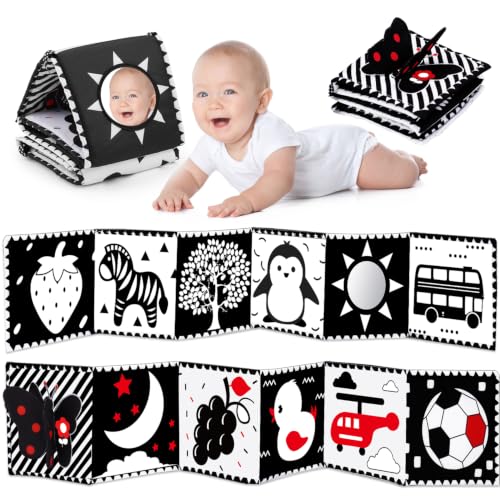
Soft books combine high contrast imagery with the sensory appeal of fabric. Crinkle pages, textured edges, and securely stitched seams make them suitable for babies who are beginning to grasp and mouth objects. These books bridge the gap between passive viewing and active exploration, and they introduce the early habit of book handling long before formal reading begins.
Contrast Mobiles and Hanging Toys
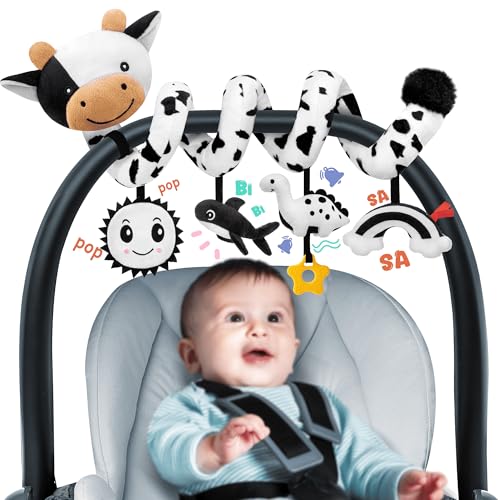
Mobiles with bold black-and-white shapes can encourage visual tracking as they move gently. Safety is paramount here: choose mobiles that are securely attached, free of long cords, and positioned well out of a baby's reach. Mobiles are best used for short, supervised periods rather than as a constant presence over the crib.
Contrast Balls, Blocks, and Sensory Toys
As babies gain motor control, contrast balls and soft blocks invite reaching, batting, and grasping. These toys combine visual stimulation with tactile variety, reinforcing the connection between what a baby sees and what they can touch. Lightweight, easy-to-grip designs suit the mid-range stage of development especially well.
If you are assembling a broader play collection, our overview of great learning toys for 1-year-olds offers a useful next step once your baby begins to transition beyond early contrast-focused play.
Comparing High Contrast Toy Types at a Glance
The table below summarizes the main toy formats by their typical position in the market and the developmental purpose they serve. Use the tier descriptors to understand relative positioning, and the "Best For" column to match a format to your baby's current needs.
| Toy Type | Tier Positioning | Best For |
|---|---|---|
| Laminated contrast card sets | Essential tier | Newborn visual focusing and supervised tummy time |
| Cloth contrast books with crinkle pages | Balanced tier | Grasping, mouthing, and early book interaction |
| Wooden or fabric contrast blocks | Mid-tier | Reaching, stacking, and tactile exploration |
| Contrast mobiles with secure mounts | Balanced tier | Short supervised visual tracking sessions |
| Soft contrast balls and sensory spheres | Essential tier | Batting, rolling, and cause-and-effect play |
| Multi-texture contrast sensory sets | High-end tier | Combined visual and tactile discovery for older infants |
Safety and Practical Tips for Contrast Play
High contrast toys are simple by design, but a few practical guidelines help ensure they remain safe and effective. First, inspect toys regularly for loose seams, peeling laminate, or detached parts. Soft books and fabric toys should be washable according to the manufacturer's instructions, and contrast cards should be wiped clean rather than submerged unless explicitly rated for water exposure.
- Supervise tummy time: Always stay within arm's reach when using contrast cards or books during tummy time, and keep sessions short at first.
- Avoid cords and ribbons: Choose toys without long strings, loose ribbons, or small detachable elements that could pose a strangulation or choking risk.
- Match complexity to stage: Start with single shapes and progress to multi-element patterns as your baby's tracking improves.
- Rotate, don't overwhelm: Offer a few contrast items at a time and rotate them to maintain novelty.
- Follow age guidance: Check the manufacturer's recommended age range on every toy, especially for items intended for unsupervised use.
For families preparing a nursery and play area, our nursery layout ideas guide includes suggestions for arranging visual stimulation zones that complement contrast play without cluttering the space.
How High Contrast Toys Support Broader Development
The benefits of contrast toys extend beyond vision. When a baby tracks a moving contrast card, they are practicing sustained attention — the ability to hold focus on a stimulus, which is a precursor to later learning. When they reach for a contrast ball, they are integrating visual information with motor planning. When they mouth a soft contrast book, they are combining sensory input from multiple systems, which supports body awareness and self-regulation.
Contrast play also creates natural opportunities for caregiver interaction. Narrating what your baby is looking at, moving a card slowly side to side, or pausing to let your baby lead all reinforce the social and communicative dimensions of play. These moments are simple but meaningful, and they do not require a large collection of toys.
Parents who are building a thoughtful play collection may also find value in our guide to great toys for 1-year-olds, which outlines how contrast-focused play evolves into more complex exploratory play as babies approach toddlerhood.
Frequently Asked Questions
Ready to Choose the Right Contrast Toys?
Explore our curated selection of high contrast toys for infants, organized to help you match the right format to your baby's stage. Every recommendation is chosen for safety, developmental appropriateness, and thoughtful design.
Explore Newborn Contrast Toys