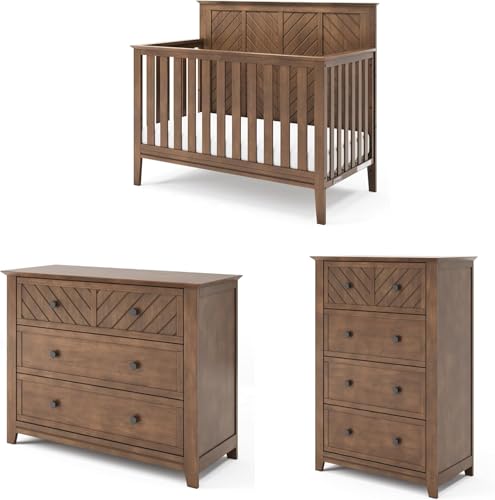
4 in 1 Convertible Crib and Dresser Set: The Complete Buying Guide
Everything you need to know before choosing a convertible nursery furniture set that grows with your child — from crib to toddler bed, daybed, and full-size bed.
START EXPLORINGWhy this guide matters: A 4 in 1 convertible crib and dresser set is one of the largest nursery investments you will make. It is also one of the few pieces that can serve your family for a decade. This guide walks you through conversion modes, safety requirements, material choices, and practical layout considerations so you can decide with confidence.
What Exactly Is a 4 in 1 Convertible Crib and Dresser Set?
A 4 in 1 convertible crib and dresser set combines two core nursery pieces into one coordinated package. The crib portion is engineered to transition through four stages: infant crib, toddler bed, daybed, and full-size bed (with a conversion kit). The dresser portion often includes a removable changing topper, so it functions as a changing station in the early months and later becomes a standalone dresser.
This design approach is popular because it reduces the number of separate furniture purchases over time. Instead of buying a crib, then a toddler bed, then a full-size bed frame, the same headboard and footboard are reused. The dresser similarly adapts from a changing surface to everyday storage. If you are comparing this to smaller setups, our guide on a 3 in 1 convertible crib with changing table explains where the two formats differ.
It is worth noting that “4 in 1” labeling varies by manufacturer. Some sets count the changing topper as the fourth mode, while others count the full-size bed conversion. Always read the product specifications to confirm exactly which configurations are supported and which conversion kits are included in the box.
Stage 1: Infant Crib
Standard crib mode with adjustable mattress height positions, typically three or four levels, so you can lower the mattress as your baby learns to sit and stand.
Stage 2: Toddler Bed
The front rail is removed or replaced with a low guard rail, allowing your child to climb in and out independently during the toddler years.
Stage 3: Daybed
With the front rail fully removed, the frame becomes a daybed suitable for lounging, reading, or a transitional sleep arrangement.
Stage 4: Full-Size Bed
The crib back panel becomes a full-size headboard. This stage usually requires a separate conversion kit and a full-size mattress, so plan ahead.
Why Parents Choose a Convertible Crib and Dresser Set
The main appeal is longevity. A well-built convertible set can remain in use from birth through the early school years. That extended lifespan changes how you evaluate the purchase: instead of comparing it only against other cribs, compare it against the total furniture you would otherwise buy across multiple stages.
There is also a practical benefit to buying the crib and dresser together. Coordinated sets are designed to share the same finish, hardware, and proportions, which simplifies nursery planning and creates a cohesive look without extra styling effort. For families working within a defined nursery footprint, a matched set also helps with space planning because the dresser dimensions are known in advance.
Finally, convertible sets tend to be built with sturdier frames than basic cribs, since the manufacturer knows the piece will be used as a full-size bed. Reinforced joinery and heavier posts are common in mid-range and premium tiers. If you are also evaluating a smaller footprint option, our overview of the 4 in 1 convertible crib with changing table covers a related configuration.
The Four Conversion Modes Explained
Understanding how each conversion works helps you evaluate whether a specific set fits your long-term plans. Below is a breakdown of what changes at each stage.
| Mode | Best For | What Changes | What You May Need |
|---|---|---|---|
| Crib | Newborn to around 2–3 years | Full four-sided frame with adjustable mattress support | Crib mattress (standard size) |
| Toddler Bed | Around 2–4 years | Front rail removed or replaced with a low guard | Toddler guard rail (often included) |
| Daybed | Transitional and lounging use | Front rail fully removed | Crib mattress or daybed mattress |
| Full-Size Bed | School-age children and beyond | Back panel becomes headboard; frame extends | Full-size conversion kit and full-size mattress |
The full-size bed conversion is the stage most often misunderstood. Many shoppers assume the full-size mattress is included, but it almost never is. The conversion kit — which typically includes side rails and a footboard — is also frequently sold separately. Check the product listing carefully so you understand the complete long-term setup.
Safety Standards You Must Verify
Safety is the non-negotiable part of this purchase. In the United States, cribs sold today must comply with federal safety standards, including the ban on drop-side rails. Look for the following when evaluating any convertible crib and dresser set:
- Fixed sides only. Drop-side cribs have been banned since 2011 and should never be purchased, including second-hand.
- Slat spacing of no more than 2 and 3/8 inches so a baby’s body cannot pass through.
- JPMA certification or equivalent third-party testing where available, indicating compliance with ASTM and CPSC requirements.
- Snug mattress fit. The mattress should leave no more than two fingers’ width of gap around the perimeter.
- Non-toxic finishes. Low-VOC and water-based finishes reduce indoor air concerns in a room where your baby sleeps.
- Stable dresser anchoring. Dressers must be secured to the wall with the included anti-tip kit. This is especially important once the changing topper is removed and drawers become accessible.
Also confirm that the set has not been subject to a recall. Checking the manufacturer’s recall history takes only a few minutes and is a standard step before any nursery furniture purchase. Our broader guide to baby furniture covers additional safety considerations for the rest of the room.
Pre-Purchase Safety Checklist
- Fixed sides, no drop-side mechanism
- Slat spacing within 2 and 3/8 inches
- JPMA or equivalent certification noted
- Anti-tip strap included for the dresser
- No recalled models in the manufacturer’s history
- Non-toxic, low-VOC finish
- Conversion kit availability confirmed for future stages
- Mattress fit verified as snug with no gaps
Materials and Build Quality
Construction quality determines how well the set survives conversion and years of daily use. The main options are solid wood, engineered wood (MDF or particleboard with veneer), and mixed constructions that use solid wood for load-bearing parts and engineered wood for panels.
Solid wood offers the most durable construction and can often be refinished if it shows wear. High-grade engineered wood with quality veneer is common in mid-range sets and performs well when joinery is reinforced. Entry-level sets sometimes use thinner panels and basic fasteners; these can work for a single child but may show wear sooner if the set is moved or reassembled.
Pay attention to the drawer hardware on the dresser portion. Metal drawer glides with a smooth extension are more durable than plastic runners. Dovetail or reinforced corner joints on drawers indicate a more solid build. For a broader look at coordinating pieces, see our guide to the baby dresser and the baby crib.
How to Choose the Right Set for Your Nursery
Start with the room dimensions, not the product photos. Measure the available wall space and account for clearance needed to open dresser drawers and to lower the crib mattress. A convertible set typically occupies more floor area than a standalone crib because the dresser is wider than a changing table.
Next, decide which conversion stages you realistically need. If you plan to move within a few years, a set that converts to a full-size bed may be less practical than one that stops at the toddler bed stage. If you intend to use the same room through the school years, the full-size conversion is a strong long-term investment.
Consider the dresser storage volume as well. A changing topper adds height but not drawer capacity. Families who plan to use the dresser as the primary clothing storage for a toddler should confirm that the drawer count and depth match their needs. Our overview of nursery storage units can help you plan the rest of the room.
Finally, check what is included versus sold separately. Conversion kits, guard rails, changing toppers, and mattresses are commonly sold separately even when the set is marketed as complete. Knowing this upfront avoids surprises later. If you are still comparing formats, our guide to the 5 in 1 convertible crib with changing table and the 6 in 1 convertible crib with changing table show how additional stages are handled.
Assembly and Long-Term Maintenance
Convertible sets arrive flat-packed and require assembly. Two adults can usually complete the build in a few hours. Follow the manufacturer’s sequence exactly, especially for the crib frame, since the mattress support height adjustment depends on correct bolt placement.
Use the included anti-tip hardware to secure the dresser to the wall before loading drawers. Re-check all fasteners after the first month of use and again after each conversion. Wood expands and contracts with humidity, so occasional tightening is normal.
Keep the conversion kit and any spare hardware in a labeled bag stored with the furniture. When the time comes to convert, having the correct rails and bolts on hand makes the transition straightforward. Avoid placing the crib near windows, cords, or wall-mounted decor that could be reached once the toddler bed stage begins.
Frequently Asked Questions
Bottom line: A 4 in 1 convertible crib and dresser set is a long-term nursery investment that rewards careful evaluation. Prioritize safety certification, fixed-side construction, material quality, and clarity about which conversion kits are included. Choose a tier that matches your expected years of use, and plan the room layout around the full-size bed dimensions if you intend to use that final stage.