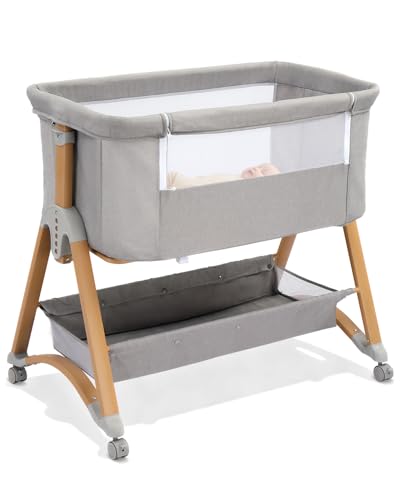
Rocking Bassinet for Newborn: The Complete Guide
Discover how a gently rocking bassinet can soothe your newborn, support safer sleep, and help the whole family rest easier during those precious early months.
Start the GuideWhy a rocking bassinet deserves a place on your registry: Newborns are accustomed to motion from their time in the womb. A rocking bassinet recreates that gentle swaying sensation, which can calm fussy babies and ease the transition to independent sleep. But not all rocking bassinets are created equal — motion mechanisms, safety certifications, and mattress quality vary widely. This guide walks you through every decision so you can choose confidently.
What Is a Rocking Bassinet?
A rocking bassinet is a compact infant sleep space designed for the first four to six months of life, equipped with a base or frame that allows gentle side-to-side or front-to-back motion. Unlike a standard stationary bassinet, the rocking motion can be manual (parent-activated) or automatic (motorized), and many models offer a lock-out feature so the bassinet can double as a stable, stationary sleeper.
Rocking bassinets sit at the intersection of two important needs: soothing motion and safe, close-proximity sleep. Many are designed as bedside sleepers, meaning one side drops down or the unit attaches to the parents' bed frame so you can tend to your newborn without leaving your own bed. If you plan to room-share — which pediatric organizations recommend for at least the first six months — a rocking bassinet can be an excellent choice.
For parents exploring broader safe sleep setups, our guide to safe sleep products explains how bassinets fit into a room-sharing plan, while our article on safe co-sleeping with a newborn clarifies the distinction between bed-sharing and room-sharing.
How Does Rocking Motion Help Newborns Sleep?
The rhythmic, repetitive motion of a rocking bassinet mimics the sensations your baby felt in utero — the sway of your movements while walking, the gentle buoyancy of amniotic fluid. This is why many newborns settle faster when they are rocked, swayed, or carried.
Research on infant sleep and vestibular stimulation suggests that gentle rocking can:
- Reduce crying episodes by activating the calming branch of the nervous system.
- Shorten the time to fall asleep, especially during the "witching hour" fussy periods in the evening.
- Help newborns transition between sleep cycles, which are short (around 50–60 minutes) in the early months.
- Support longer stretches of sleep for both baby and parents when used safely.
That said, motion is a tool — not a requirement. Some babies self-soothe well without it, and some parents prefer a stationary bassinet for simplicity. A rocking bassinet with a lock-out option gives you both: motion when you need it, stillness when your baby is ready for independent sleep habits.
Types of Rocking Bassinets: Which One Fits Your Home?
Rocking bassinets fall into several categories based on their motion mechanism and placement. Understanding the differences will help you narrow down the right fit for your nursery or bedroom.
Manual Rocking Bassinets
These require a gentle push from a parent to set the bassinet in motion. The frame is typically lightweight, and the rocking arc is calibrated so that a light nudge keeps the cradle swaying for a minute or more. Manual models are often entry-level to mid-range in market position, simple to maintain, and free of motors or batteries. They are ideal for parents who want to be actively involved in soothing and don't mind a small amount of hands-on effort.
Motorized (Automatic) Rocking Bassinets
Motorized bassinets use a built-in motor to produce continuous or intermittent rocking, often with adjustable speed and timer settings. These are usually mid-range to premium in position and appeal to parents who want hands-free soothing, especially during nighttime feedings or when managing multiple children. Look for models with a quiet motor (under 50 decibels) and a smooth, gradual start-stop cycle rather than abrupt jerking.
Bedside Sleeper Rocking Bassinets
These combine rocking motion with a drop-side or zip-down panel so the bassinet can sit flush against your bed. They are designed for room-sharing and make nighttime nursing or bottle-feeding much easier. Many bedside rocking bassinets are mid-range to premium and include height-adjustment features to match different bed heights. If you plan to breastfeed through the night, pair this with our breastfeeding guide for setup tips.
Rocking Bassinet Attachments and Convertibles
Some systems combine a bassinet with a rocking chair or glider, so the sleep space and the parent's soothing seat are integrated. Our article on a rocking chair with bassinet attached explores this hybrid category in detail. These setups are often premium to luxury in positioning and work well for small nurseries where multi-function furniture saves floor space.
If you are designing a nursery from scratch, our nursery layout ideas guide can help you position the bassinet for safe airflow, easy access, and minimal disruption to the rest of the room.
Rocking Bassinet Features Compared by Tier
The table below summarizes how rocking bassinets differ across market tiers. Remember: a higher tier generally means more features and refined materials, but the best choice depends on your lifestyle, bedroom setup, and how much motion support your newborn needs.
| Feature | Essential Tier | Balanced Tier | Top-Tier |
|---|---|---|---|
| Motion type | Manual rock only | Manual + optional motorized sway | Motorized with multi-speed & timer |
| Bedside compatibility | Standalone only | Some models with drop-side | Height-adjustable bedside sleeper |
| Mattress | Basic foam pad | Waterproof, breathable foam | Premium breathable, dual-density foam |
| Frame | Lightweight aluminum or plastic | Reinforced aluminum with solid joints | High-grade steel or solid wood frame |
| Lock-out feature | Often absent | Standard on most models | Always included, with auto-lock |
| Portability | Foldable, moderate weight | Quick-fold with carry handle | One-hand fold, travel-friendly |
| Extras | Basic storage pocket | Storage basket, toy bar, music | Night light, vibration, app control |
The descriptor tiers above are universal and do not reflect specific currencies. In general, entry-level models cover the core motion function reliably, mid-range models add bedside compatibility and better mattress materials, and top-tier models include motorized features, premium fabrics, and smart add-ons.
Rocking Bassinet Safety: What Every Parent Must Know
⚠️ Non-Negotiable Safety Rules
Always place your baby on their back on a firm, flat mattress with a fitted sheet. Never add pillows, blankets, or bumpers to a bassinet. Stop using the bassinet as soon as your baby can roll over, push up on hands and knees, or reach the weight limit specified by the manufacturer — whichever comes first.
Rocking bassinets introduce motion into a sleep environment, which raises a few specific safety considerations:
- Lock the rock function during sleep. Most pediatric guidance recommends a stationary, flat sleep surface for unsupervised sleep. Use the rocking motion to soothe your baby, then engage the lock-out feature before you step away or fall asleep yourself.
- Check for stability. A rocking bassinet should have a wide, stable base and a locking mechanism that engages securely. Avoid models that wobble or tip when the motion is engaged.
- Verify certifications. Look for compliance with the applicable bassinet safety standard in your region (for example, the CPSC bassinet standard in the United States, or the corresponding EN standard in Europe).
- Keep the sleep surface clear. No soft bedding, toys, or positioners inside the bassinet — these are suffocation hazards for newborns.
- Mind the motor. Motorized models should have a quiet, smooth drive with no pinch points accessible to little fingers. Check that the power cord is routed away from the sleep area.
For a broader checklist of what to look for in any infant sleep product, see our safe sleep products guide. If you're considering a bedside setup, our article on safe co-sleeping with a newborn explains how to keep the space adjacent to your bed safe and free of gaps.
How to Choose the Right Rocking Bassinet for Your Newborn
With so many models on the market, it helps to break the decision into a few practical steps. Use the checklist below as a framework when you compare options online or in a store.
- Confirm the motion type fits your routine. Manual rocking is ideal if you plan to actively soothe your baby. Motorized rocking suits parents who want hands-free calming during night feeds.
- Measure your bedroom space. A bedside rocking bassinet needs clearance on both sides and enough room for the drop-side panel to open fully.
- Check the height adjustment range. For bedside sleepers, the bassinet should align with your mattress height to prevent gaps. Compare the adjustable range against your bed frame.
- Inspect the mattress. A firm, flat, breathable mattress with a snug-fitting sheet is essential. Avoid models with soft or contoured sleeping surfaces.
- Test the lock-out mechanism. It should engage firmly and be easy to operate one-handed in the dark.
- Look for a quiet motor. If you choose a motorized model, read reviews about motor noise — a loud motor defeats the purpose of soothing.
- Plan for the transition out. Most bassinets are outgrown by four to six months. Choose a model that is easy to disassemble and store, or consider a convertible design.
- Verify the safety certification. Check the product label or manual for the applicable bassinet safety standard and any recall history.
If you are also choosing a glider or rocker for the nursery, our guides to a rocking chair and a rocking chair for the nursery can help you coordinate the furniture. And for small spaces, a small-space rocking chair for the nursery pairs well with a compact rocking bassinet.
Pros and Cons of Rocking Bassinets
Advantages
- Motion can calm fussy newborns quickly
- Supports room-sharing and nighttime feeds
- Compact footprint compared to cribs
- Many models convert to stationary sleepers
- Portable options travel well
Considerations
- Short usable lifespan (4–6 months)
- Motorized models may have motor noise
- Motion must be locked for unsupervised sleep
- Bedside models require precise height matching
- Some models are heavy for travel
Weighing these points against your daily routine will point you toward the right configuration. Parents who value hands-free soothing and night feeds tend to prefer motorized bedside sleepers, while parents who prioritize simplicity often favor manual rockers with a lock-out.
Transitioning Out of the Rocking Bassinet
Most newborns outgrow a rocking bassinet between four and six months, or sooner if they begin to roll, sit up, or exceed the weight limit. The transition to a crib can be smoother if you prepare in advance:
- Introduce the crib during daytime naps first, so nighttime sleep changes are less abrupt.
- Keep the same bedtime routine — bath, feed, story, dim lights — so the change in sleep space is the only variable.
- Gradually reduce motion in the final weeks, using the lock-out feature more often so your baby adapts to a still surface.
- Maintain room-sharing if possible, moving the crib into your bedroom for the remainder of the recommended six-month period.
If you are planning the next stage of sleep gear, our guides on cribs and bassinets and crib mattresses can help you choose a safe, comfortable crib setup. For parents researching nursery furniture that grows with the child, our overview of nursery furniture sets is a useful next read.
Frequently Asked Questions
Is it safe for a newborn to sleep in a rocking bassinet?
Yes, provided the bassinet is used correctly. Place your baby on their back on a firm, flat mattress, lock the rocking motion during unsupervised sleep, and keep the sleep surface free of blankets, pillows, and toys. Always follow the manufacturer's weight and age limits, and stop using the bassinet as soon as your baby can roll over or push up.
Should I choose a manual or motorized rocking bassinet?
Manual rocking bassinets are simpler, lighter, and suit parents who are comfortable soothing their baby hands-on. Motorized models offer continuous motion with adjustable speed and timers, which can be helpful for night feeds and for parents managing multiple children. If you choose motorized, prioritize a quiet motor and a smooth start-stop cycle.
How long can my baby use a rocking bassinet?
Most newborns use a rocking bassinet for four to six months. The exact timeline depends on your baby's growth: stop using the bassinet when your baby reaches the manufacturer's weight limit, begins to roll over, or can push up on hands and knees — whichever comes first. After that, transition to a crib or a larger safe sleep space.
Can a rocking bassinet replace a crib?
No — a rocking bassinet is a temporary sleep space for the first few months. It is not designed for long-term use, and most babies outgrow it well before their first birthday. Plan for a crib or a convertible toddler bed for the next stage. Many parents use a bassinet for room-sharing and a crib in the nursery for later.
What should I look for in a bedside rocking bassinet?
Look for a model with height adjustment that matches your bed, a secure drop-side or zip-down panel, and a firm, flat mattress. Check that the bassinet can be locked into a stationary position and that the attachment mechanism (if any) leaves no gaps between the bassinet and your mattress. Verify the applicable safety certification before use.
Do rocking bassinets help with colic or reflux?
Gentle motion can soothe a fussy baby, but it is not a treatment for colic or reflux. If your baby has persistent feeding or digestive issues, consult your pediatrician. Our colic relief guide and sensitive stomach formula for newborns article provide additional context for those conversations.
Final Thoughts
A rocking bassinet for a newborn is one of the most practical pieces of gear you can add to your registry. It gives you a safe, close-proximity sleep space, a soothing motion tool for fussy evenings, and a bedside setup that makes nighttime feeds more manageable. Focus on the essentials — a firm flat mattress, a reliable lock-out, and a stable base — and let the motion type and tier fit your routine rather than the other way around.
As you continue preparing, our guides to baby gear and baby registry checklist will help you build a complete, practical list. And if you are still deciding on a soothing seat for yourself, our article on a rocking chair with ottoman covers the parent-side comfort piece that pairs naturally with a rocking bassinet.