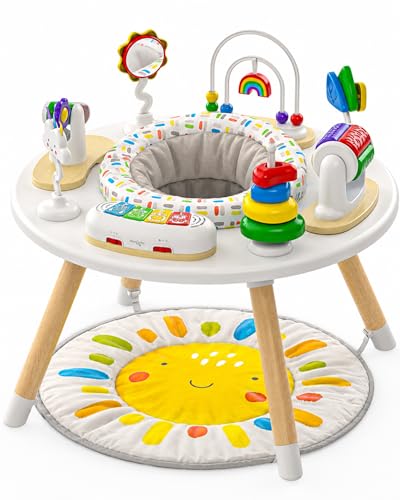
What Is an Infant Activity Center?
An infant activity center, often referred to as a stationary activity center or jumper, is a self-contained play station designed for babies who can hold their heads up. Unlike traditional walkers, these centers have a fixed base, allowing your baby to bounce, spin, and interact with a variety of toys in a secure environment. They are a popular choice for providing entertainment and encouraging sensory and motor skill development while giving parents a safe place to set their baby down.
These centers are distinct from play mats or gyms, as they offer an upright, 360-degree play experience. The best models are designed with a strong emphasis on safety, featuring a wide, stable base and a secure seat. They are an excellent tool for fostering curiosity and providing a fun, engaging space for your little one to explore.
Key Features to Consider
When choosing an activity center, not all models are created equal. The right choice for your family will depend on your baby's age, your living space, and your developmental goals. Here are the primary features to evaluate:
Developmental Toys and Activities
The toys on an activity center are its main attraction. Look for a variety of interactive elements that stimulate different senses. This can include:
- Fine Motor Toys: Spinners, clicking dials, and bead mazes that encourage grasping and finger dexterity. These are great for developing skills similar to those used with fine motor skills toys for 6 month old.
- Cause-and-Effect Toys: Buttons that play sounds, pop-up toys, and mirrors that reward a baby's action with a reaction, a key concept in early learning. You can find more examples in our guide to cause and effect toys for 6 month olds.
- Sensory Elements: Textured fabrics, crinkly materials, and musical components that engage touch and hearing.
Seat and Adjustability
The seat is where your baby will spend their time, so comfort and support are paramount. A seat with a high back provides better head and neck support. Adjustability is a major plus. Many mid-range and premium models offer multiple height settings, allowing the center to grow with your baby. This ensures their feet can touch the floor or a platform, which is essential for safe bouncing and jumping. Some high-end tier models even feature seats that spin 360 degrees for easy access to all the toys.
Footprint and Portability
Consider where you plan to use the activity center. Some are large and feature a wide, circular base, which is very stable but takes up significant floor space. For smaller homes, a space-saving design or a foldable model might be a better fit. If you plan to move it between rooms, look for lightweight models with built-in handles. Entry-level models are often simpler and lighter, while top-tier models may be more feature-rich but heavier.
Safety First: What to Look For
Safety is the non-negotiable factor when choosing any baby product. An activity center must provide a secure environment for your baby to play.
- Stable Base: The base should be wide enough to prevent tipping, even if your baby leans or bounces vigorously.
- Secure Harness: A five-point harness or a secure seat with leg openings that prevent slipping are essential. Always strap your baby in.
- Age and Weight Limits: Strictly adhere to the manufacturer's guidelines. These centers are for babies who can hold their head up unassisted (typically 4+ months) and have a weight limit. They are not for newborns.
- No Sharp Edges or Pinch Points: Inspect the product for any potential hazards. The construction should be smooth and well-finished.
- Compliance with Safety Standards: Look for models that meet current safety regulations (e.g., ASTM F2012 in the US). Avoid hand-me-downs from unknown sources, as safety standards have evolved.
It's important to remember that an activity center should be used for short periods. Floor play is critical for developing crawling and walking skills. Think of an activity center as a supplement, not a replacement, for tummy time and free movement on a play mat.
Activity Center vs. Other Play Gear
Parents often wonder how an activity center compares to other common baby gear like a newborn swing or a play gym.
- Activity Center vs. Play Gym/Mat: A play gym is used from birth and is essential for tummy time and early visual and motor development while lying down. An activity center is for older babies who are ready for upright, supported play.
- Activity Center vs. Swing: A swing is primarily a soothing device for calming and sleeping. An activity center is an active, engaging play station that encourages movement and interaction.
- Activity Center vs. Walker: Traditional walkers with wheels have been banned in some countries and are strongly discouraged by pediatric organizations due to safety hazards (falls down stairs, access to hazards). Stationary activity centers are a safer alternative as they do not move across the floor.