Children's Wooden Folding Table and Chairs: A Complete Guide
Everything you need to know before choosing a space-saving, durable wooden table and chair set for your child.
START READINGWhy a wooden folding set? Parents searching for a children's wooden folding table and chairs are usually looking for two things: a sturdy surface their child can use every day, and a set that folds away when the room needs to be reclaimed. This guide walks you through the construction, safety, folding mechanism, and the practical trade-offs of wooden folding sets so you can decide with confidence.
What Makes a Wooden Folding Table and Chairs Set Different?
A children's wooden folding table and chairs set combines two categories of furniture that are usually sold separately: a solid wood kids' table, and chairs that either fold flat or tuck under the table. Unlike molded plastic tables, a wooden set brings the warmth and weight of natural timber — which matters both aesthetically and functionally, because a heavier table stays put when a child leans on it or climbs up.
The folding element is what separates this category from a standard children's wooden table and chairs set. Folding legs, hinged table tops, or collapsible chairs allow the whole set to be stored in a closet, behind a door, or under a bed. For families in apartments, or for grandparents who want a table that appears only when the grandchildren visit, that single feature often decides the purchase.
If you are comparing this category against non-folding options, our overview of children's folding table and chairs covers the broader folding market, including plastic and metal variants. The wooden version sits at the more durable end of that spectrum.
Key Features to Evaluate Before You Buy
1. Wood Type and Finish
Most children's wooden folding tables use one of three constructions: solid hardwood (beech, birch, rubberwood), engineered wood (MDF or plywood with a veneer), or a hybrid where the top is solid and the folding frame is engineered. Solid hardwood handles knocks and spills better and can be sanded and refinished later. Engineered wood is flatter and more dimensionally stable, which matters for a folding top that needs to sit flush, but it does not tolerate moisture around the edges as well.
Look for a water-based, non-toxic finish. Children will spill juice, press crayons into the grain, and wipe the surface with whatever is nearest. A sealed, low-VOC finish makes daily cleanup realistic and keeps the table usable for years.
2. The Folding Mechanism
This is the component that most often determines whether a set is pleasant to own or frustrating. Three mechanisms dominate the market:
Hinged Table Top
The table top folds in half along a central hinge, and the legs fold flat underneath. Compact when stored, but the hinge line can collect crumbs and needs a smooth, gap-free fold.
Folding Legs Only
The top stays rigid and the legs collapse inward. Simpler mechanism, fewer pinch points, and usually the more stable option when unfolded.
Collapsible Chairs
Chairs fold flat or nest. Check that the folding joint locks positively when open — a chair that folds unexpectedly under a child is a genuine hazard.
Whatever the mechanism, test the locking action. A well-designed folding joint clicks or locks into place and requires a deliberate two-step action to release. Avoid sets where the table or chair can be collapsed by a child pushing sideways on it.
3. Dimensions and Age Suitability
Children's tables are sized by seat height rather than table height. A table around 50–53 cm tall with a 27–30 cm seat height suits most children from roughly three to seven years old. Below that, toddlers need a lower set or a booster; above it, the table becomes cramped and children start kneeling or standing. If you need a longer usable lifespan, an adjustable-height set is worth considering — our guide to children's adjustable table and chairs explains how those mechanisms work.
Chair seat depth and back height matter as much as table height. A chair that is too deep forces a child to slouch forward to reach the table; one that is too shallow gives no back support. Check that the chair back reaches at least mid-shoulder for a child in the target age range.
4. Stability and Weight Capacity
A folding table is only as stable as its leg splay and locking joints. Look for legs that angle outward rather than straight down, and for a brace or crossbar connecting the legs. Weight capacity figures are published for most sets; treat them as a ceiling, not a target, and remember that children lean, climb, and rock — a table rated for a static load needs margin for that movement.
5. Edge Treatment and Safety
Rounded or chamfered edges are standard on well-made children's furniture and should be non-negotiable. Check for exposed hardware, sharp hinge plates, and gaps at the folding joint that could pinch small fingers. Any set you consider should carry a recognizable safety certification for children's furniture in your region.
Understanding the Market: Quality Tiers
Wooden folding sets for children fall into three broad tiers. Rather than quoting figures that change constantly, here is how the tiers differ in construction and expected lifespan:
| Tier | Typical Construction | Best For |
|---|---|---|
| Entry-level | Engineered wood with veneer, simple hinge, basic folding legs, lighter frame | Occasional use, grandparents' homes, a first table for a toddler |
| Mid-range | Solid hardwood top or thick engineered core, reinforced locking joints, sealed finish | Daily use, craft and homework, families who want one set to last several years |
| Premium | Solid hardwood throughout, precision hinges, adjustable or tool-free assembly, multi-layer finish | Heavy daily use, multiple children, a set intended to be passed down |
The jump from entry-level to mid-range is usually the most meaningful one: it buys you a genuinely stable table and a locking mechanism that will not loosen after a few months of folding and unfolding. Premium sets mostly add refinement and longevity rather than a different fundamental experience.
How to Choose the Right Set: A Practical Checklist
- Measure your storage space first. Folded dimensions are the whole point of a folding set — confirm the folded footprint actually fits where you plan to keep it.
- Match seat height to your child's age. Feet should rest flat on the floor when seated, with knees at roughly a right angle.
- Test the folding action in person if possible. It should move smoothly, lock firmly, and require a deliberate release.
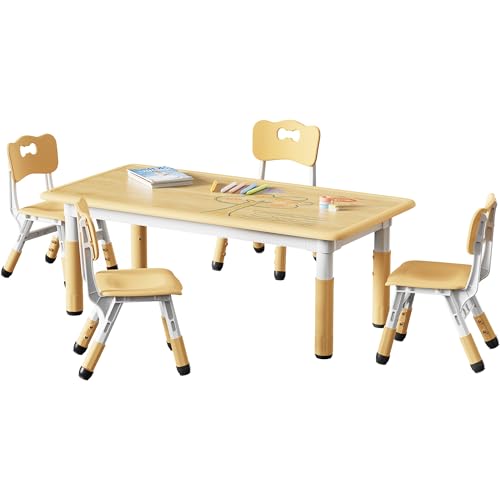
- Check the chair-to-table ratio. Two chairs is typical; four-chair sets need a longer table to avoid crowding. Our guide to children's table and 4 chairs sets covers the space requirements.
- Confirm the finish is sealed and child-safe. Water-based, low-VOC, and wipe-clean.
- Look for rounded edges and covered hardware. No exposed bolt ends, no sharp hinge plates.
- Consider the room it will live in. If the set doubles as a craft or homework station, a slightly larger top is worth the extra folded bulk.
- Factor in assembly. Most sets require some assembly; tool-free or pre-assembled folding joints are a meaningful convenience.
Wooden Folding Sets vs Plastic and Metal Alternatives
Plastic folding tables are lighter and handle outdoor use and water play without concern, but they flex under load and the folding joints on lightweight models tend to loosen over time. Metal frames are strong but introduce hard edges and a colder look that many families do not want in a playroom.
Wood sits in the middle: heavier than plastic, warmer than metal, and repairable in a way neither is. A solid wood top can be sanded and resealed if it gets scratched; a plastic or coated metal top generally cannot. If the table will be used indoors for drawing, puzzles, snacks, and homework, wood is usually the more satisfying long-term choice.
If your priority is purely light weight and portability, a children's plastic table and chairs set may serve better. But for a set that stays in one room and folds away only occasionally, wood is the sturdier investment.
Caring for a Wooden Folding Set
Wipe spills promptly, especially along the fold line and around the leg joints where moisture can sit. Avoid soaking the hinges; a damp cloth and a dry follow-up is enough. Check the locking joints every few months — folding mechanisms loosen with use, and a quick tighten of the hardware keeps the set safe. Keep the set out of prolonged direct sunlight, which can dry and crack solid wood over time. If the finish dulls, a light sanding and a fresh coat of child-safe sealant restores both appearance and wipe-cleanability.
Frequently Asked Questions
What age is a children's wooden folding table and chairs set suitable for?
Most sets are designed for roughly three to seven years old. The limiting factor is seat height: once a child's feet no longer rest comfortably on the floor, the set is too small. Some adjustable sets extend that range.
Are folding wooden tables stable enough for daily use?
Mid-range and premium sets with locking joints and braced legs are stable enough for daily drawing, snacks, and homework. Entry-level sets with simple hinges are better suited to occasional use.
Can a child fold or unfold the set themselves?
Most folding mechanisms are designed for adult operation. A positive-lock mechanism that requires a deliberate release is safer, but it also means younger children will need help.
How much space does a folded set take up?
That varies widely by design. Hinged-top tables fold to roughly half their open footprint plus leg thickness; folding-leg tables collapse to the table top's dimensions. Always check the published folded dimensions against your storage space.
Is solid wood better than engineered wood for a folding table?
Solid wood is more repairable and handles knocks better. Engineered wood is flatter and more dimensionally stable, which can help a folding top sit flush. Both are workable; the finish and the folding hardware matter more than the wood type alone.
Related guides on CradleCheck:
- Children's Wooden Table and Chairs
- Children's Folding Table and Chairs
- Children's Folding Table and Chairs Set
- Children's Adjustable Table and Chairs
- Children's Table and 4 Chairs
- Children's Plastic Table and Chairs
- Children's Activity Table with Storage
- Children's Table and Chairs with Storage
- Children's Tables