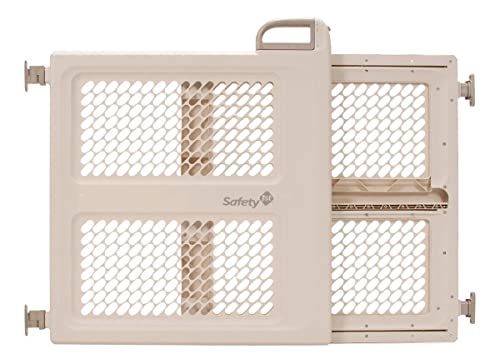
What Is a 2-in-1 Super Wide Safety Gate and Play Yard?
A 2-in-1 super wide safety gate and play yard is a convertible baby safety product built from interlocking panels. In gate mode, it stretches across wide doorways, open-plan room dividers, or the bottom of a staircase. In play yard mode, those same panels lock together into a freestanding enclosure where your baby can crawl, play, and explore safely while you keep an eye on them.
What makes the "super wide" label meaningful is panel count. A standard gate covers a normal doorway. A super wide model adds enough panels to span large openings that a fixed gate simply cannot reach. The same extra panels are what let the unit fold into a full play yard, so you are effectively getting two products from one box.
This category has become popular with parents who live in open-plan homes, who want one product for multiple rooms, or who prefer a play area that can travel with them. If you are still deciding whether a dedicated enclosed space fits your routine, our guide to the pop and jump portable activity center is a useful companion read for understanding how play enclosures support developmental play.
Quick definition: Gate mode = a wide safety barrier. Play yard mode = a freestanding panel enclosure. Same panels, two configurations, one product to store and maintain.
Why a Convertible Gate and Play Yard Makes Sense
Baby proofing rarely stays static. A gate that blocks a hallway today may be irrelevant once your toddler learns to open a latch or once you rearrange furniture. A convertible panel system adapts instead of becoming obsolete. Here are the practical advantages parents tend to notice most:
- One product, two jobs: You are not storing a separate playpen and a separate gate in a closet.
- Flexible coverage: Add or remove panels to fit wide, awkward, or unusually shaped openings.
- Room-to-room portability: Pressure-mounted panel systems can often be moved without drilling new holes.
- Multi-zone safety: Use it as a gate at the stairs and as a play yard in the living room on the same day.
- Longer usable life: Panel systems often serve from newborn tummy time through the toddler years.
If your priority is a dedicated containment space for a younger baby, a baby play gym serves a different purpose — sensory and motor development rather than boundary safety. Many families use both, with the play yard as the safe outer boundary and the gym as the activity inside it.
Key Features to Evaluate Before Buying
1. Panel Count and Maximum Span
The number of panels determines how wide the gate can go and how large the play yard enclosure will be. Fewer panels mean a more compact yard; more panels mean wider spans and more open play space. Measure the widest opening in your home before shopping, then confirm the model's stated maximum span with a small buffer for hardware and wall cups.
2. Mounting Method: Pressure vs Hardware
Pressure-mounted gates wedge against the walls using tension. They are easy to move and leave no holes, but they are not appropriate for the top of stairs. Hardware-mounted gates screw into wall studs or door frames and are the correct choice for stair safety. Many convertible play yard configurations rely on pressure mounting, so confirm the model's stair rating before relying on it as a stair barrier.
3. Walk-Through Door and Latch Design
A gate you have to climb over is a gate you will eventually stop using. Look for a full walk-through door with a one-hand or two-hand release, and check that the latch is genuinely child-resistant. A gate that opens easily for you is a gate that a determined toddler should not be able to open.
4. Bar Spacing and Panel Height
Narrow bar spacing prevents a small head from slipping through. Panel height matters too: a taller panel buys you more months before a climber figures it out. Check the manufacturer's stated minimum and maximum child height and weight for each configuration.
5. Freestanding Stability in Play Yard Mode
In play yard mode, the enclosure should stand without wobbling when a baby pulls up on a panel. Look for weighted feet, anti-slip pads, or a base that distributes force evenly. A yard that shifts when a toddler leans on it is a fall risk, not a safety feature.
6. Materials and Finish
Solid build and a rust-proof finish matter in a product that will be wiped down constantly. Metal frames with reinforced joints hold up better than thin tubular frames. If the panels are mesh, check that the mesh is tightly woven and that the seams are double-stitched.
7. Portability and Storage
Convertible units are heavier than single-purpose gates because they carry more panels. Check the folded footprint and whether the panels stack flat. If you plan to travel with it, look for a carry bag and confirm the collapsed dimensions fit your vehicle.
Entry-Level vs Mid-Range vs Premium: What Changes
Convertible safety gates and play yards cluster into clear market tiers. Rather than framing these as spending levels, here is what typically improves as you move up the tier ladder.
| Tier | Typical Panel Build | Best For | What Improves Upward |
|---|---|---|---|
| Entry-level tier | Fewer panels, lighter tubular frame, pressure mount only | Single wide doorway, occasional play yard use | Baseline baseline |
| Mid-range tier | More panels, reinforced joints, dual-mode mounting, walk-through door | Multi-room use, open-plan homes, daily play yard setup | Smoother latches, better anti-slip feet, tighter bar spacing |
| Premium tier | Heavy-duty frame, hardware-mount option, stair-rated configurations | Stair safety, large enclosures, long-term multi-child use | Solid build, rust-proof finish, one-hand operation, modular expansion panels |
| Commercial-grade | Thick-gauge steel, welded joints, high panel count | Childcare settings, shared play spaces, high-traffic use | Maximum durability, institutional latch design, replacement panel availability |
Most families land in the mid-range tier because it is where walk-through doors, dual mounting, and reinforced joints converge. The premium tier earns its place when stairs are involved or when the product will pass through more than one child. Our related guide on the extra wide dog gate pressure mounted is worth a look if you are comparing pressure-mount hardware in a wide-opening context, since the mounting mechanics overlap.
Installation: Getting the Setup Right
Convertible gates fail in the same handful of ways, and almost all of them are installation errors rather than product defects. Work through these steps carefully.
Measure the Opening Properly
Measure the distance between the widest points of the opening, not at floor level only. Door frames and walls are rarely perfectly plumb, so take measurements at the top, middle, and bottom and use the widest figure. Add the hardware allowance stated in the manual before confirming the panel count.
Choose the Correct Mount for the Location
At the bottom of a staircase, a pressure-mounted configuration can work if the manufacturer rates it for that location and the wall surface holds tension. At the top of stairs, hardware mounting into studs is the safe choice. Never place a pressure-mounted gate at the top of a staircase, regardless of how tight it feels.
Test the Latch and the Gap
After installation, check that the latch fully engages, that the walk-through door closes on its own or with a light push, and that there is no gap at the floor or walls that a small child could work a limb through. Pull firmly on the panels in play yard mode to confirm the feet do not slide.
Safety check: Re-check the tension and hardware every few weeks. Children lean on gates far more than adults expect, and a gate that was snug in month one can loosen by month four.
Using the Play Yard Mode Well
A play yard is a boundary, not a babysitter. Used well, it gives your baby a defined space with safe toys while you handle chores nearby. Used poorly, it becomes a place where frustration builds. A few practical habits help:
- Keep the space interesting: Rotate toys so the enclosure stays engaging. Small developmental items work better than a single large toy.
- Place it where you are: A yard in the living room where you can see and talk to your baby beats a yard in a distant room.
- Build a routine: Short, frequent play yard sessions tend to work better than long stretches, especially for younger babies.
- Pair it with floor play: Tummy time and free movement on an open mat remain important for motor development.
- Check the floor surface: A firm, even surface under the yard keeps the panels level and the feet planted.
For older babies moving toward toddlerhood, a potty training chair and other independence tools eventually replace the yard as the main developmental focus, but the enclosure remains useful as a safe zone during transitions.
Who Should Choose a 2-in-1 Convertible Gate and Play Yard?
This category suits households that want flexibility over single-purpose equipment. It is a strong fit if you have wide openings, an open-plan layout, or a need to reconfigure safety barriers as furniture moves. It is also a reasonable choice for grandparents' homes or second homes where you want one product that covers multiple scenarios.
It may not be the best fit if you have a single narrow doorway and no need for an enclosure, in which case a simpler gate does the job. And if stair safety at the top of a staircase is the primary need, buy a dedicated hardware-mounted stair gate rather than relying on a convertible unit rated only for pressure mounting.
Families building out a full baby-proofing kit often pair the gate with other safety items. If you are also setting up sleep and play spaces, our guides on the baby bassinet and the portable infant bassinet cover the sleep side of the same safety planning.
Frequently Asked Questions
What is a 2-in-1 super wide safety gate and play yard?
It is a convertible baby safety product made from interlocking panels. In gate mode it blocks wide openings; in play yard mode the same panels form a freestanding enclosure. You get two configurations from one set of panels.
How wide can a super wide safety gate extend?
It depends on panel count. Super wide models add panels beyond a standard gate, allowing them to span large openings. The same extra panels are what enable the play yard configuration. Always confirm the manufacturer's stated maximum span.
Is a 2-in-1 gate and play yard safe for stairs?
Only if the specific model is rated for stair use and is hardware-mounted. Pressure-mounted gates must never be used at the top of a staircase. Check the product manual for the exact stair rating before installing.
What age is a play yard suitable for?
Play yards are generally used from newborn through toddler age, depending on panel height and the manufacturer's height and weight limits. Always supervise and follow the stated guidelines.
Can I move the play yard between rooms?
Pressure-mounted panel systems are often portable enough to move between rooms, though they are heavier than single-purpose gates. Hardware-mounted configurations are intended to stay in place.
How many panels do I need?
Measure your widest opening, add the hardware allowance from the manual, then choose a panel count that exceeds that figure. For play yard mode, more panels mean a larger enclosure — decide which configuration matters more to you.
Final Thoughts
A 2-in-1 super wide safety gate and play yard earns its place in a baby-proofing setup when you choose the right tier for your home. Prioritize the mounting method first, because that determines where the product can safely be used. Then evaluate panel count, latch design, and freestanding stability. Parents who get those three right usually find the convertible format pays for itself in flexibility across rooms and across months.
Take your measurements, confirm the stair rating, and match the tier to how hard the product will work in your household. The rest — panel colors, carry bags, and accessory add-ons — is personal preference.