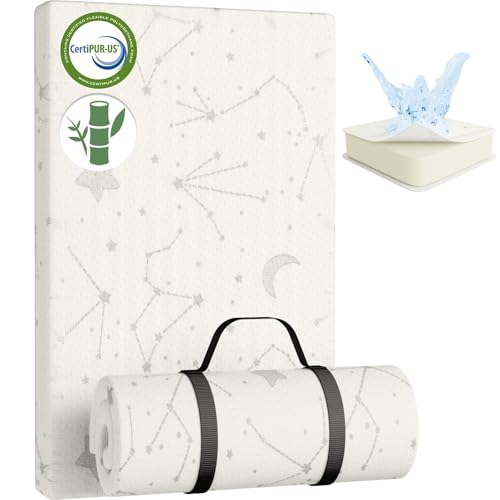
Replacement Mattress for Pack and Play: The Complete Guide
Everything you need to know before upgrading your playard mattress — sizing, firmness, materials, safety standards, and how to pick the right replacement for your family.
START THE GUIDEA replacement mattress for Pack and Play is one of those purchases parents do not think about until the original pad starts to sag, stain, or lose its shape. Yet the mattress is the single most important comfort and safety surface your baby will use during travel, naps, and overnight sleep in a playard. Getting the right replacement is not simply about finding a softer pad — it is about matching the exact dimensions of your playard, understanding firmness requirements for infant sleep, and choosing materials that hold up to real-world use.
This guide walks you through everything a research-stage buyer needs: how playard mattress sizing works, why a standard crib mattress will not fit, which materials perform best, how firmness affects safe sleep, and how to evaluate quality tiers without relying on guesswork. By the end, you will be able to compare options confidently and choose the mattress that fits your playard, your baby, and your routine.
Quick takeaway: The safest replacement mattress is a firm, flat, tightly fitting pad designed specifically for your playard model. Avoid soft, plush, or oversized mattresses, and never add extra padding on top of the original pad for infant sleep.
Why Parents Replace the Original Pack and Play Mattress
Most playards ship with a thin, foldable pad that is functional but minimal. It is designed to fold with the frame and keep the travel footprint compact — not to provide long-term comfort. Over time, that original pad tends to develop creases, flatten out, or accumulate stains that no longer come clean. Parents typically look for a replacement in four situations:
- Comfort for longer sleep: A slightly thicker replacement pad can make overnight sleep in a playard more comfortable for babies who have outgrown the newborn stage.
- Wear and sagging: Original pads often compress in the center after months of use, leaving an uneven sleep surface.
- Hygiene: Spills, diaper leaks, and spit-up can permanently stain a non-removable original pad.
- Hand-me-down playards: A second-hand playard may come without a pad, or with one that is no longer usable.
If you are also refreshing other parts of your travel setup, our guide to a portable crib mattress for Pack N Play covers how portable options compare, while the Pack N Play mattress cover with zipper article explains how a quality removable cover extends the life of any pad.
Sizing: Why Fit Is the Most Important Factor
Playard mattress sizes are not universal. Although many popular models share a similar footprint, manufacturers differ by an inch or more in each dimension, and the corners are often rounded or angled differently. A mattress that is even slightly too small creates a gap between the pad and the playard walls — a serious entrapment and suffocation hazard for infants. A mattress that is too large will not sit flat, causing the sleep surface to buckle.
How to Measure Your Playard Correctly
- Set up the playard fully and lock all sides.
- Measure the interior length and width at the base, from wall to wall.
- Measure the corner radius or note whether the corners are square or rounded.
- Check the maximum thickness your playard's base and sidewalls can accommodate without lifting the pad above the safety line.
- Compare your measurements with the replacement mattress specifications — not with a generic "standard" size.
Typical Playard Mattress Dimensions
| Category | Typical Fit | Best For |
|---|---|---|
| Standard playard pad | Fits most 4-sided playards with rounded corners | Families with a mainstream playard model |
| Mini crib / portable crib pad | Fits mini cribs and select portable playards | Travel cribs and compact playards |
| Brand-specific replacement | Exact fit for a single manufacturer's playard | Owners of a specific playard who want a guaranteed fit |
When in doubt, always choose the brand-specific replacement over a universal pad. A verified exact fit is worth more than any feature on a generic mattress.
Thickness and Firmness: Finding the Right Balance
Thickness and firmness are the two specs parents ask about most, and they matter for different reasons. Thickness affects comfort and portability; firmness affects safe sleep. The ideal replacement mattress is firm enough to support an infant's spine and airway, yet thick enough to smooth out the playard's hard base.
What Thickness Should You Choose?
- 1 inch or less: Entry-level replacement pads. Lightweight and highly portable, but offer minimal cushioning — best as a travel backup or for short naps.
- 1.5 to 2 inches: The balanced tier for most families. Provides noticeably better comfort than the original pad while still folding or rolling for travel.
- 2.5 to 3 inches: Premium comfort for longer overnight sleep. Check your playard's depth and safety line carefully, as a thicker pad raises the sleep surface.
Firmness and Safe Sleep
For infants, the sleep surface must be firm and flat. A mattress that is too soft can allow a baby's face to sink in, increasing suffocation risk. Replacement mattresses marketed for infants are usually made with high-density foam or firm fiber cores precisely for this reason. If you plan to use the playard as a primary sleep space, prioritize firmness over plushness without exception.
Firmness also affects longevity: high-density cores resist the body-shaped indentations that softer foams develop over months of use.
Materials Compared: Foam, Fiber, and Airflow Cores
The core material determines how the mattress feels, how it holds up, and how easy it is to clean. Most replacement mattresses fall into three material families:
High-Density Foam
The most common choice. High-density foam holds its shape well, provides a firm flat surface, and is available in a range of thicknesses. Premium and top-tier models use denser foam that resists compression for years. Look for foam described as "firm" or "high-density" rather than "soft" or "plush."
Fiberfill and Batting
Lightweight, foldable, and often machine-washable. Fiber cores are excellent for travel because they pack down easily, but they compress over time and generally suit short-term or occasional use better than nightly sleep.
Airflow and Breathable Cores
Newer designs use perforated foam or engineered mesh channels to improve air circulation around the sleep surface. These are a worthwhile investment for warmer climates or babies who tend to sleep warm, and they are increasingly common in mid-range and premium options.
Cover Materials
- Waterproof covers: Essential for diaper leaks and spit-up. A wipe-clean surface dramatically extends mattress life.
- Removable, zippered covers: The best option for hygiene — machine washable and easy to inspect for wear.
- Organic cotton covers: A premium touch for sensitive skin; check that the waterproof layer underneath does not compromise breathability.
Quality Tiers: How to Compare Replacement Mattresses
Because product specifications vary so widely, the clearest way to compare replacement mattresses is by tier. The table below uses a consistent classification from essential to flagship so you can match a mattress to your use case.
| Tier | Typical Characteristics | Best For |
|---|---|---|
| Essential tier | Thin fiber or basic foam core, simple fitted cover, lightweight | Occasional travel and short naps |
| Mid-tier | High-density foam around two inches, waterproof wipe-clean cover | Regular naps and weekend travel |
| Premium | Denser foam, removable zippered cover, airflow channels, exact-fit design | Frequent overnight sleep in a playard |
| Flagship tier | Brand-specific engineering, dual-firmness or breathable core, machine-washable cover | Primary sleep space and long-term daily use |
A practical rule: the more nights per week your baby sleeps in the playard, the higher the tier you should consider. A mattress used twice a month for travel can be essential-tier; one used every night should be premium or flagship.
Safety Checklist Before You Buy
Replacement mattresses are aftermarket products, so safety verification is your responsibility. Run through this checklist for any candidate:
- Exact fit: No gaps larger than a finger's width between the mattress edge and the playard wall.
- Firm and flat: The surface should not indent around the baby's head. If you can press a deep handprint that stays, it is too soft for infant sleep.
- Correct thickness: The mattress must not raise the sleep surface above the playard's maximum fill line or interfere with the locking mechanism.
- No added soft bedding: Do not place the replacement mattress on top of the original pad if doing so creates instability — use one or the other.
- Material transparency: Prefer products that state foam density, core material, and cover composition.
- Recall awareness: Check consumer safety recall databases for both the playard and the mattress before first use.
- Age guidance: Follow the playard manufacturer's guidance on when a child has outgrown the bassinet insert or raised level.
If your baby is ready to transition out of the playard bassinet level, our guide to the portable crib mattress for Pack N Play explains how lower-level sleep surfaces are configured safely.
Care and Cleaning to Extend Mattress Life
A replacement mattress will outlast the playard itself if you protect it properly. The single most effective habit is using a waterproof, fitted cover — and keeping a spare on hand for middle-of-the-night changes.
- Wipe weekly: Use a damp cloth with mild soap on the waterproof surface, then air-dry fully before replacing bedding.
- Wash covers monthly: Follow the care label; most zippered covers are machine washable on a gentle cycle.
- Avoid soaking the core: Foam cores that absorb water can grow mold. Never submerge a foam mattress in water.
- Rotate and air: After travel, air the mattress out for a few hours before storing to prevent trapped moisture.
- Inspect seams: Re-tape or replace a cover as soon as seams split, since exposed foam is difficult to clean.
For families who want a fully removable, washable outer layer, see the Pack N Play mattress cover with zipper guide for what to look for in a replacement cover.
Step-by-Step Buying Guide
Use this sequence to narrow your options efficiently:
- Identify your playard model and look up its official interior dimensions.
- Decide your use case: travel-only, regular naps, or nightly sleep. This determines your tier.
- Choose a core material based on climate, portability needs, and cleaning habits.
- Confirm the cover system: waterproof is non-negotiable; removable and washable is strongly preferred.
- Verify the fit claim against your measurements — not against a "standard" size.
- Check firmness language and avoid any product described as plush or soft for infant use.
- Read recent reviews focused on long-term durability and real-world fit.
- Confirm return policy in case the fit is not exact when it arrives.
Common Mistakes to Avoid
- Buying a standard crib mattress for a playard — it will not fit.
- Choosing thickness over fit — an oversized pad is a safety problem, not an upgrade.
- Adding a foam topper or quilted pad for infants — extra softness is not safe for sleep.
- Ignoring the playard's fill line when using a thicker replacement.
- Skipping a waterproof cover and then replacing the mattress early due to stains.
Frequently Asked Questions
Can I use a regular crib mattress in a Pack and Play?
No. Standard crib mattresses are larger than playard mattresses. Using an ill-fitting mattress creates dangerous gaps where a baby can become trapped. Always choose a mattress specifically designed for your playard model.
How thick should a replacement mattress for a Pack and Play be?
Most replacement mattresses range from one to three inches thick. Around two inches usually balances comfort and portability. Anything too thick may interfere with the playard's structural limits or raise the sleep surface above the fill line.
Are replacement Pack and Play mattresses safe for overnight sleep?
Only if the mattress is firm, flat, and tightly fitting, and is approved for your specific playard. Soft or loosely fitting mattresses are not safe for infant sleep. Always follow the manufacturer's guidance for sleep use.
How often should I replace a Pack and Play mattress?
Replace it when it no longer lies flat, develops sagging or indentation, shows tears, or the cover no longer cleans properly. Many parents replace it after heavy use or when passing the playard to a second child.
Do I need a waterproof cover if the mattress already has one?
A built-in waterproof surface is a strong start, but a separate fitted waterproof cover adds a washable layer that protects the mattress from leaks and stains. Keep a spare cover for night-time changes.
Can a thicker replacement mattress make the playard unsafe?
Yes, if it raises the sleep surface above the playard's maximum fill line or prevents the sides from locking securely. Always check your playard's depth and follow its stated limits before choosing a thicker pad.
Final Thoughts
A replacement mattress for a Pack and Play is a small purchase with an outsized effect on your baby's comfort and safety during travel and sleep. Prioritize an exact fit above all else, choose a firm, flat surface for infants, and select a cover system you can actually keep clean. Once those boxes are ticked, tier and material choices become straightforward — and your playard becomes a genuinely comfortable second sleep space.
If you are also comparing portable options or refreshing your travel setup, explore our related guides on portable crib mattresses for Pack N Play and zippered Pack N Play mattress covers.