Developmentally Appropriate Toys for 12 Month Old
Your little one is officially a toddler! Discover which toys truly support walking, problem-solving, and language development at this exciting stage.
In This Guide
The 12-month milestone is a turning point. Your baby is transitioning from infant to toddler, and their play is evolving rapidly. They are likely pulling to stand, cruising along furniture, and perhaps taking those first independent steps. Their hands are becoming more precise, their curiosity is insatiable, and they are beginning to understand cause and effect on a deeper level.
At this stage, the best toys are not the most complex or the most feature-packed. They are the ones that match your child's current abilities while gently stretching them toward the next milestone. This guide breaks down exactly which toys support development at 12 months, how to evaluate quality tiers without relying on price tags, and how to build a play collection that grows with your child.
Key Developmental Milestones at 12 Months
Before choosing toys, it helps to understand what your 12 month old is working on. While every child develops at their own pace, most one-year-olds are mastering several overlapping skill sets simultaneously.
Gross Motor Skills
Your child is building the strength and coordination needed for independent movement.
- Pulling up to stand and cruising along furniture
- Taking first steps or walking with support
- Bending down to pick up objects while holding on
- Climbing onto low surfaces
Fine Motor Skills
Hand control is becoming more refined, moving from whole-hand grasping to pincer grip.
- Picking up small items with thumb and index finger
- Stacking two to three blocks
- Putting objects into containers and taking them out
- Turning pages of a board book
Cognitive Development
Cause-and-effect understanding is expanding rapidly at this age.
- Exploring objects by shaking, banging, and dropping them
- Finding hidden objects (object permanence)
- Imitating simple actions like clapping or waving
- Understanding simple words and directions
Language & Social Skills
Communication is blossoming, even before first words emerge.
- Babbling with varied sounds and intonation
- Pointing to indicate wants
- Responding to their name and simple instructions
- Engaging in back-and-forth play with caregivers
Why Developmentally Appropriate Toys Matter
A toy that is too advanced frustrates a child; a toy that is too simple bores them. Developmentally appropriate toys hit the sweet spot — challenging enough to engage, but achievable enough to build confidence. At 12 months, the right toys accomplish several things:
- Support physical transitions — pushing toys, climbing structures, and walking aids help your toddler practice new gross motor skills safely.
- Encourage problem-solving — shape sorters, stacking toys, and cause-and-effect toys build cognitive pathways through trial and error.
- Develop fine motor precision — toys that require grasping, pinching, and manipulating small parts refine hand-eye coordination.
- Foster language and social interaction — books, pretend play props, and interactive toys create opportunities for back-and-forth communication.
- Build independence — toys your child can operate on their own boost confidence and self-directed exploration.
Essential Toy Categories for 12 Month Olds
Instead of buying individual toys randomly, think in terms of categories. A well-rounded collection covers each area of development without overwhelming your child or your living space.
1. Movement & Mobility Toys
These toys encourage your toddler to practice walking, pushing, and balancing. Look for push-behind walkers with adjustable resistance (so they don't roll away too fast) and sturdy construction that won't tip when your child leans on it. Avoid sit-in walkers, which are not recommended for development and pose safety risks around stairs.
- Push-behind walkers with weighted bases
- Wooden or sturdy plastic push carts
- Soft climbing blocks and cushions for safe climbing practice
- Balls of various sizes (large enough to not be a choking hazard)
2. Stacking, Nesting & Building Toys
These classics never go out of style for a reason. Stacking cups, ring towers, and large building blocks develop fine motor skills, spatial awareness, and the concept of size ordering. At 12 months, your child may not build a perfect tower yet, but they will love knocking one down and experimenting with how objects fit together. Look for toys that are large enough to be safe for mouthing, since many one-year-olds still explore orally.
- Soft or large plastic stacking cups
- Wooden ring stacking towers with a stable base
- Large, lightweight building blocks (cardboard or foam)
- Nesting dolls or boxes
3. Cause-and-Effect Toys
Your 12 month old is fascinated by how their actions produce results. Toys with buttons, levers, knobs, and pop-up mechanisms teach the basics of cause and effect while building hand strength and coordination. Choose toys with clear, immediate feedback — a button that makes a sound, a lever that pops open a lid, or a dial that spins.
- Pop-up toys with levers and buttons
- Simple activity boards with knobs and switches
- Toys that make sounds when shaken or rolled
- Busy boxes with multiple mechanisms
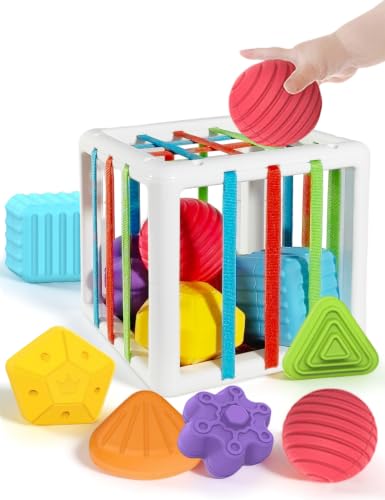
4. Shape Sorters & Problem-Solving Toys
Shape sorters are quintessential 12-month toys. They teach trial and error, shape recognition, and fine motor control. At this age, choose sorters with fewer shapes and larger pieces. Your child will likely need help at first, but as they approach 18 months, they will begin to match shapes independently. This builds the foundation for more complex puzzles later.
- Basic shape sorters with 3-5 shapes
- Simple peg puzzles with large knobs
- First blocks with textured edges
- Posting toys (dropping objects through slots)
5. Books & Language Toys
Board books are among the most developmentally valuable toys you can offer a 12 month old. They build vocabulary, strengthen the caregiver-child bond, and teach the mechanics of reading (turning pages, following along). Choose books with clear, high-contrast images, simple text, and interactive elements like flaps or textures. Songs and rhyming books are especially engaging at this age.
- Sturdy board books with simple, bold images
- Touch-and-feel books with textured patches
- Lift-the-flap books (with thick, durable flaps)
- Books with mirrors or interactive elements
6. Pretend Play & Everyday Objects
Pretend play doesn't fully blossom until closer to 18-24 months, but 12 month olds love imitating everyday actions. Toy phones, play keys, soft dolls, and simple pretend food items encourage role-play and social-emotional development. You can also offer safe household objects (wooden spoons, plastic bowls) for open-ended exploration — sometimes the simplest things are the most engaging.
- Soft dolls or stuffed animals (with no small parts)
- Toy phones and keys
- Play food with large pieces
- Child-safe household objects for exploration
Quality Tier Comparison: What to Look For at Each Level
Not all toys in the same category are created equal. Instead of focusing on price, evaluate toys by their materials, construction, and developmental value. Here's how toys typically differ across quality tiers in the 12-month toy market.
| Tier | Best For | What to Expect |
|---|---|---|
| Entry-Level | Testing a new toy category or occasional use | Basic functionality with lightweight plastic construction. May lack refinement in mechanisms but meets safety standards. Good for trying out whether your child gravitates toward a particular type of play. |
| Mid-Range | Everyday play and long-term durability | Solid build with better materials — often a mix of sturdy plastic and wood. Mechanisms operate more smoothly than entry-level options. Designed to withstand daily use and sibling hand-me-downs. |
| Premium | Families who value longevity and design | High-grade materials, often solid wood or BPA-free premium plastics. Excellent craftsmanship with smooth edges, durable finishes, and thoughtful design. Often designed to be kept as heirlooms or passed along. |
| Top-Tier / Professional-Grade | Developmental specialists or intensive daily use | Designed with input from child development experts. Focus on open-ended play, natural materials, and minimalistic design that grows with the child. Often Montessori-aligned or Waldorf-inspired. |
A good rule of thumb: invest more in toys that your child will use daily and that serve multiple developmental purposes (like building blocks or board books). For novelty toys or those your child may outgrow quickly, an entry-level or mid-range option is often sufficient.
Safety Checklist for 12-Month-Old Toys
At 12 months, children are still mouthing objects, and their motor skills are unpredictable. Safety should be your first filter when choosing any toy.
⚠️ Essential Safety Criteria
- Choking hazard check: Avoid any toy or removable part that fits entirely inside a standard toilet paper tube (approximately 1.75 inches / 4.4 cm in diameter). This is the standard choking hazard test.
- No small parts: Avoid toys with buttons, beads, or detachable pieces that could break off. Check seams and joints regularly for wear.
- Non-toxic materials: Ensure toys are labeled BPA-free, phthalate-free, and lead-free. Look for water-based, non-toxic paints on wooden toys.
- No sharp edges or points: Run your hand over all surfaces. Wooden toys should be smoothly sanded; plastic toys should have no rough molding seams.
- Sturdy construction: Toys should not tip easily when your child leans on them. Push toys should have a wide, stable base.
- No long cords or strings: Avoid toys with strings longer than 12 inches (30 cm) to prevent strangulation risk. This includes pull toys with long cords.
- Age-appropriate labeling: Look for toys labeled "12 months+" or "1 year+." Toys labeled for 3+ are not safe for this age group.
- Battery safety: Battery compartments should require a screwdriver to open. Avoid toys with easy-access battery compartments.
Toys to Avoid at 12 Months
Some toys are popular but not developmentally appropriate or safe for one-year-olds. Here are categories to skip for now:
- Toys with small magnets: If swallowed, magnets can attract each other across intestinal walls, causing serious injury. Avoid any toy with magnetic parts for children under 3.
- Screen-based electronic toys: At 12 months, passive screen time offers limited developmental value compared to hands-on play. The American Academy of Pediatrics recommends avoiding screen media for children under 18 months (except video chatting).
- Sit-in baby walkers: These are associated with delayed motor development and significant injury risk (especially near stairs). Push-behind walkers are a safer, more developmentally supportive alternative.
- Toys with small removable parts: Anything that can detach and fit in the mouth is a choking hazard. This includes toy cars with small wheels, dolls with button eyes, and toys with snap-on accessories.
- Overly complex electronic toys: Toys that do too much on their own (lights, sounds, moving parts activated without child input) can overwhelm and reduce active engagement. Simple, child-operated toys are better for this age.
- Balloons and inflatable toys: Deflated or popped balloons are a leading choking hazard. Avoid balloons entirely for children under 3.
The Toy Rotation Strategy: Less Is More
One of the most effective strategies for 12 month olds is toy rotation. Instead of keeping every toy accessible at once, rotate a small selection (5-8 toys) every one to two weeks. This approach has several benefits:
- Reduces overwhelm: Too many choices can overstimulate a toddler and lead to scattered play. Fewer toys encourage deeper engagement.
- Renews interest: Toys that have been put away feel "new" when they reappear, extending their useful life.
- Encourages focused play: With fewer distractions, children spend more time exploring each toy in depth, which builds concentration and problem-solving skills.
- Keeps play areas manageable: Less clutter means safer play spaces and easier cleanup for parents.
Pair your rotation strategy with a simple storage system. Open bins or low shelves that your child can reach independently support the development of self-help skills and make cleanup part of the play routine. For ideas on organizing toys and creating an accessible play space, explore our storage solutions and toy storage organizer with bookshelf guides.
Building a Play Collection That Grows With Your Child
As your toddler moves through 12 months and beyond, their play needs will shift. Explore our related guides on developmental toys for other ages and nursery organization to stay one step ahead.
Explore Toys for 6 Month OldsFrequently Asked Questions
How many toys does a 12 month old actually need?
What are the best first toys for a 12 month old who is just starting to walk?
Are electronic toys bad for 12 month olds?
How do I know if a toy is developmentally appropriate for my 12 month old?
Should I buy toys labeled for older children if my 12 month old is advanced?
What are the best toys for encouraging language development at 12 months?
How often should I rotate toys for my 12 month old?
Choosing toys for a 12 month old is about matching their boundless curiosity with safe, engaging tools that support their next developmental leap. Focus on quality over quantity, prioritize open-ended play, and rotate your collection to keep playtime fresh and focused. For more guidance on setting up a play space and organizing your home for a growing toddler, explore our baby storage and storage solutions resources.